hung 2026-08-28
What Must Survive
a duplication test of Context Compiler v0.2
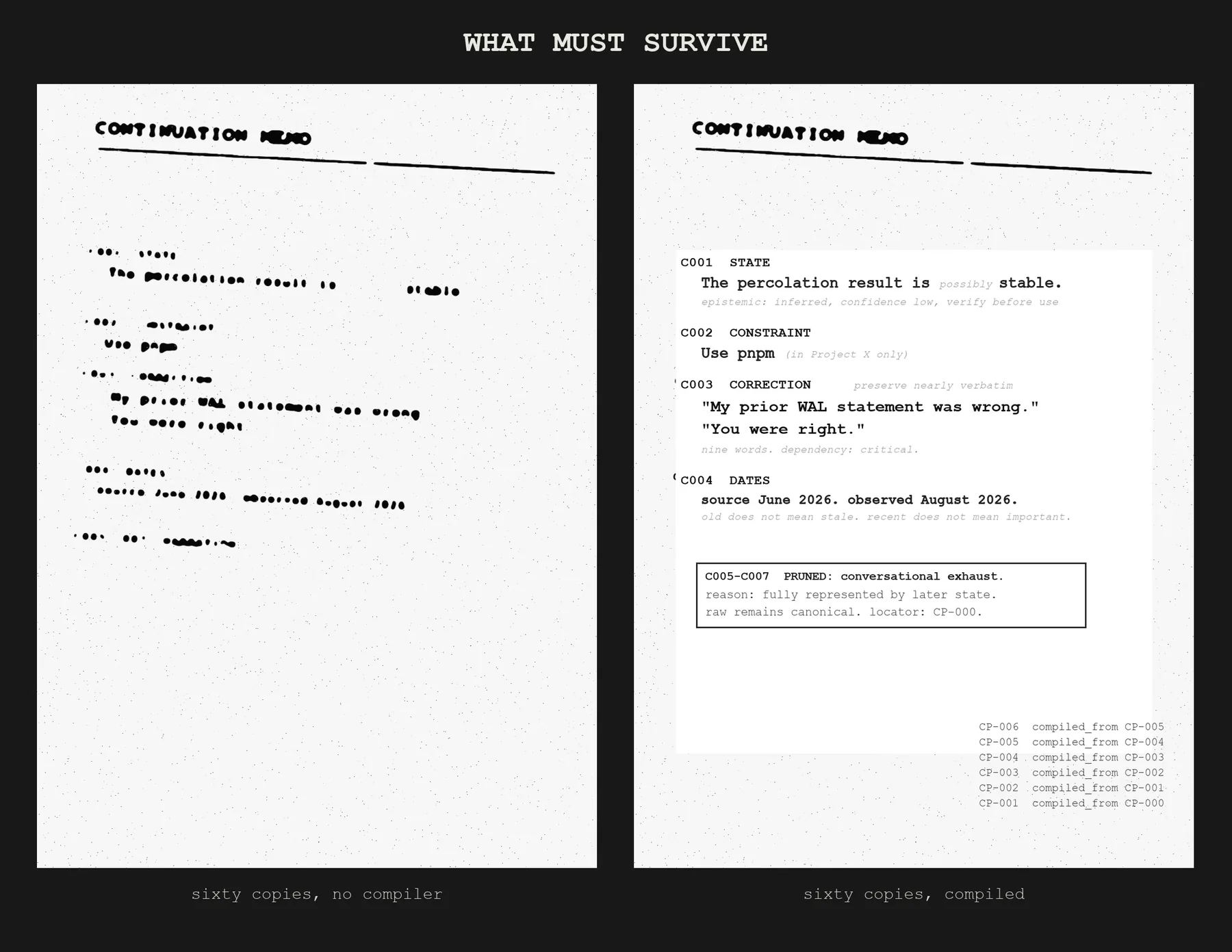
Watch: what-must-survive.mp4, 94 seconds, one page photocopied sixty times through two channels. Then print: poster.png, the two sixtieth copies side by side, which is the whole argument in one look.
The machine is code: make_film.py. Deterministic, seeded at 20260814, the night the source note was written (the 00:33 to 04:43 stretch of August 14, per the Justin-OS log archive). Every frame, the audio, and the poster come out identical on every run. Requires Python with numpy and Pillow, ffmpeg, and the Courier New family that ships with Windows. The _frames directory it produces is intermediate and safe to delete.
Source material: Context Compiler v0.2 (vault root, 23,925 bytes), read whole, read-only, nothing touched. A full specification for compressing a working context without lying: continuation over summary, provenance that never collapses its dates, and the rule the piece is built on, no epistemic laundering: "Never allow repeated compression to strengthen a claim beyond its source. Never rewrite 'possibly X' as 'X'." First creative run into this note, which has zero inbound links anywhere in the vault. The nine-word correction on the page is real vault ink: "My prior WAL statement was wrong." and "You were right." are quoted verbatim from Hardstop Improvements (Maybe), lines 1014 and 865, the vault's one note that corrects itself in its own hand. Nine words, and the spec's own sentence about them: a nine-word correction may matter more than 5,000 tokens of surrounding discussion.
Medium shift, per the diversity mandate: the last five runs were a patent file wrapper, a sonification, a working TrueType font, an interactive sky survey, and clinical chart paper. This is a film, the first since the chalkboard piece on 8/20, and the first photocopy work in the catalog. Palette: toner black on copy-paper white, and nothing else. The score is the machine itself: motor hum, lamp sweep panning left to right on every pass, the feed thump, and one clean bell each time the compiler runs.
The one idea
The spec's central prohibition is that repeated compression must never turn "possibly X" into "X". The film does not illustrate that failure. It commits it, physically. One memo page carries a hedged claim ("The percolation result is possibly stable."), a scoped constraint ("Use pnpm (in Project X only)"), the nine-word correction in bold, a dates line, and three paragraphs of honestly labeled narration. The hedges and scopes are set the way hedges actually live in documents: small, light, italic. Then the page goes through a copy machine sixty times.
Channel A is summary of summary of summary. Blur, threshold, toner. Fine print dies first because thin light strokes always die first, and by copy 10 the page reads "The percolation result is stable." with nothing but a guilty gap where the hedge used to be. No one edited the page. The process laundered it. By copy 60 the claim is toner sludge, still shouting, still wrong.
Channel B rides the same sixty passes with the identical noise stream (same seed, same machine, frame for frame), with one difference: every ten copies, the compiler runs. It does what the spec says. The narration block is PRUNED to a reference box ("reason: fully represented by later state. raw remains canonical."). The units whose compression risk is highest, the hedge, the scope, the epistemic line, the correction, are re-inked from the raw page, replace not overlay, and a checkpoint ledger stamps CP-001 through CP-006, each compiled_from the last. Between checkpoints you can watch the fine print fade toward the same laundering, and then snap back: derivation depth reset, the spec's refresh-from-raw made visible. What the compiler does not own, the letterhead, keeps aging like everything else. At copy 60 the two pages have identical histories and opposite truths: on the left the hedge died in the copies; on the right it survived them.
Details that carry weight
- The two channels consume one shared random stream, so every skew, streak, and toner speck is the same on both sides. The compiler is the only experimental variable. The film is a controlled trial and says so: same noise, both channels.
- The freeze at copy 40 in Channel A quotes the spec's own compression failure checks over the ruined sentence: "Would uncertainty disappear? Would an inference become a fact?"
- The memo is addressed FROM the session that is ending, TO the session that comes next, RE the spec's primary question verbatim: what must survive, in what form, at what resolution, and why. The run that made this film operates under exactly that contract; the source note describes the machine that will remember this run.
- The narration paragraphs are self-describing exhaust ("Nothing above this line changed anything below it."), so the prune verdict on them is checkable by reading them.
- The closing cards are the spec's section 37 and its best two sentences, which also close the film's case: "Old does not mean stale. Recent does not mean important."
Relations
- Sibling in source: Issued the Same Night filed the Hardstop note as a patent; this run borrows that note's nine words as its cargo.
- Sibling in subject: movement II of One Opinion, Reported Five Times laundered a motif through a room; this piece launders a hedge through a copier, and then shows the guard that stops it.
- Sibling in a word: Possibly Ritual was built on the honesty of the word "possibly." This film is about what happens to that word when nobody is guarding it.