hung 2026-08-25
Wants to Move, Not How
specimens of the FoldClock Foundry
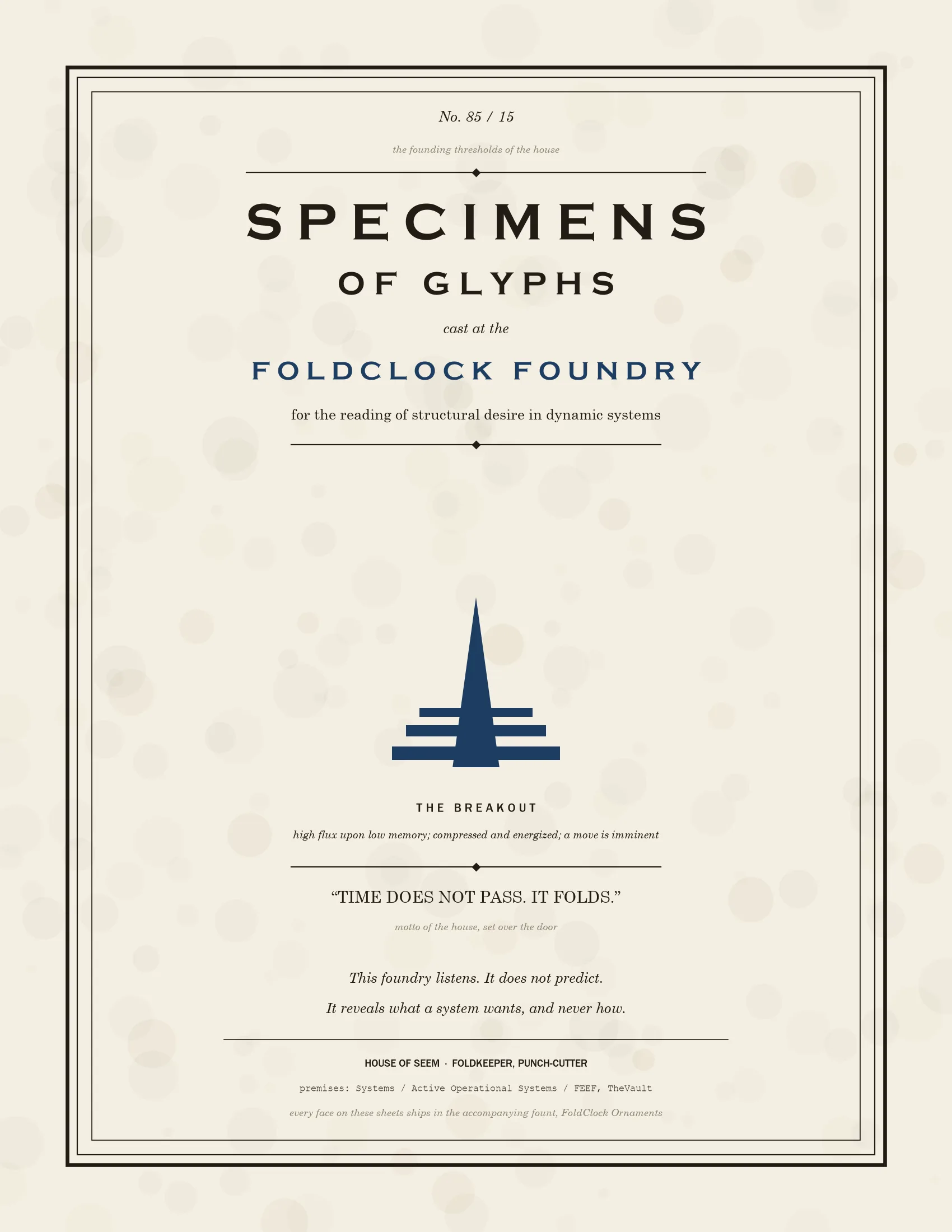
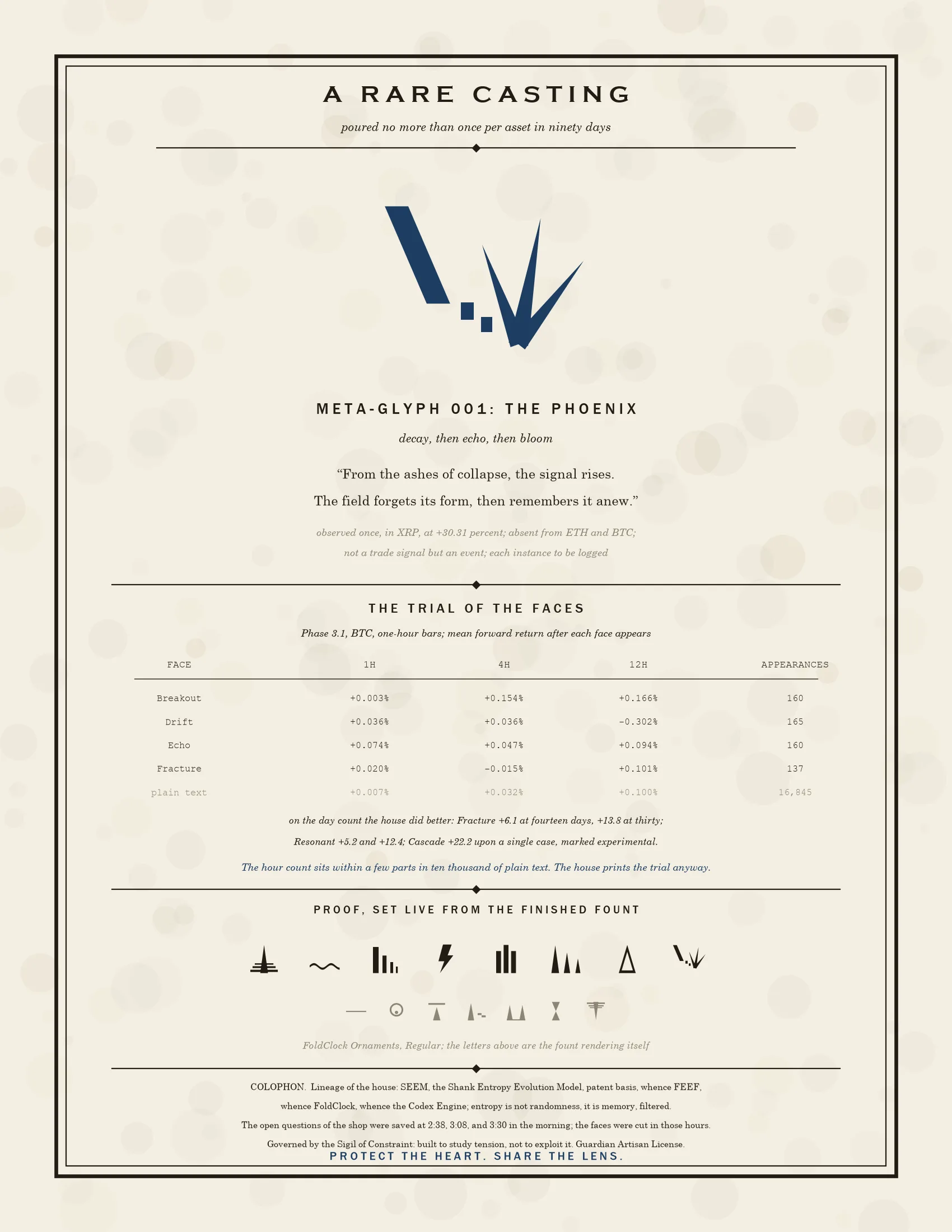
Open: sheet1-title.png through sheet5-phoenix.png, five pages of a type foundry's specimen book: title page, the canonical faces, the metals and the bodies, the discontinued cuts, and the rare casting with the trial and colophon. Then install FoldClockOrnaments.ttf, because this run's fount is real: double-click, install, and type. Capital B D E F R C P X set the canonical faces; lowercase f s w d g h v set the cuts no longer offered. The proof line on sheet 5 is not an illustration of the font, it is the font, rendering itself.
The foundry is code: foundry.py. One script cuts the fifteen glyph forms, compiles the TrueType file with fontTools, and pulls all five sheets with the same geometry. Deterministic, seeded at 20250504, the date on FoldClock Genesis v1.0. Run it twice, get the same book twice. Requires Python with numpy, matplotlib, and fontTools, plus the Century Schoolbook, Franklin Gothic Medium, Copperplate Gothic Bold, and Courier New fonts that ship with Windows.
Source material: the FEEF corpus in the Systems lane, read whole, read-only, nothing touched: FEEF System Hub, Glyph Atlas, Rare & Experimental Glyphs, Codex-Locked Detection Logic, Validated Glyphs, Meaning to Action, FoldClock Genesis, Phoenix Meta-Glyph, Glyph Return Profiles, Cluster Groups, the lineage log, and the Artisan Starter Kit. First creative run into the Systems lane.
Medium shift, per the diversity mandate: the last five runs were an interactive HTML sky survey, clinical chart paper, a Spotify playlist, line-printer manual pages, and a chalk film. This is a type specimen book, and the first working font in the catalog: the piece does not depict the alphabet, it ships it. New palette too: warm specimen stock, press black, and a single Prussian blue for the second working.
The one idea
In January, deep in a 72-hour grind, Justin carved a written language for market tension. Not indicators: glyphs. The Breakout, the Fracture, the Phantom. The system that finds them was named like a bell: FoldClock. Its founding sentence is on the title page as the house motto, "Time does not pass. It folds," and its design philosophy is the piece's title: FEEF "detects when a system wants to move, not how."
A vocabulary of visual archetypes, carved, validated, retired, recut: that is not a metaphor for a type foundry, that is the job description of one. So the piece takes the vault at its word and prints the specimen book the glyphs never got. The old foundry grammar fits without force applied:
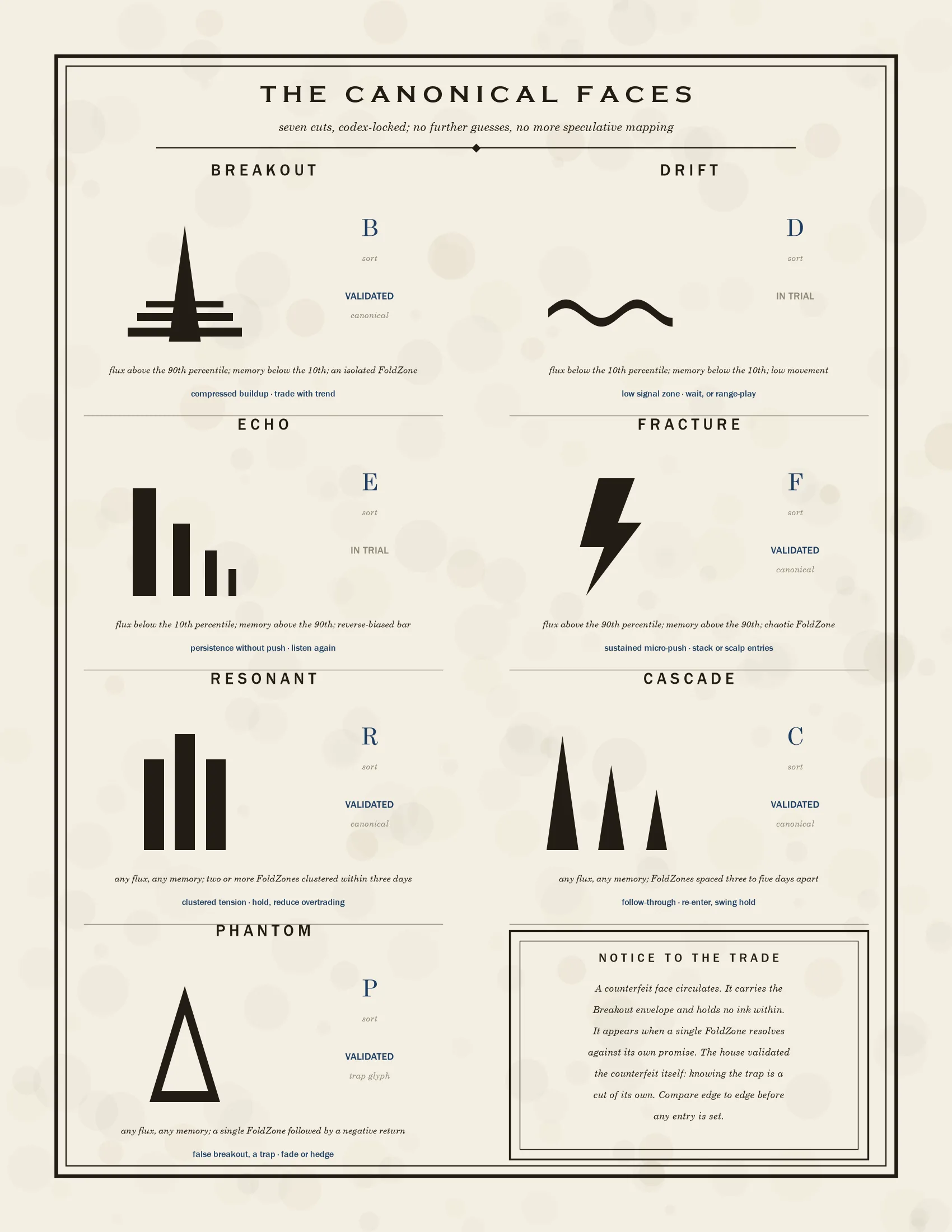
- The faces. The seven codex-locked glyphs get formal cuts: solid geometric marks derived from their flux and memory signatures. The detection conditions are printed under each face exactly as the codex locked them (Breakout: flux above the 90th percentile, memory below the 10th, an isolated FoldZone), and the Meaning-to-Action line rides beneath in blue. Five faces carry the VALIDATED stamp because five glyphs are canonical by the vault's own sheet; Drift and Echo are marked IN TRIAL.
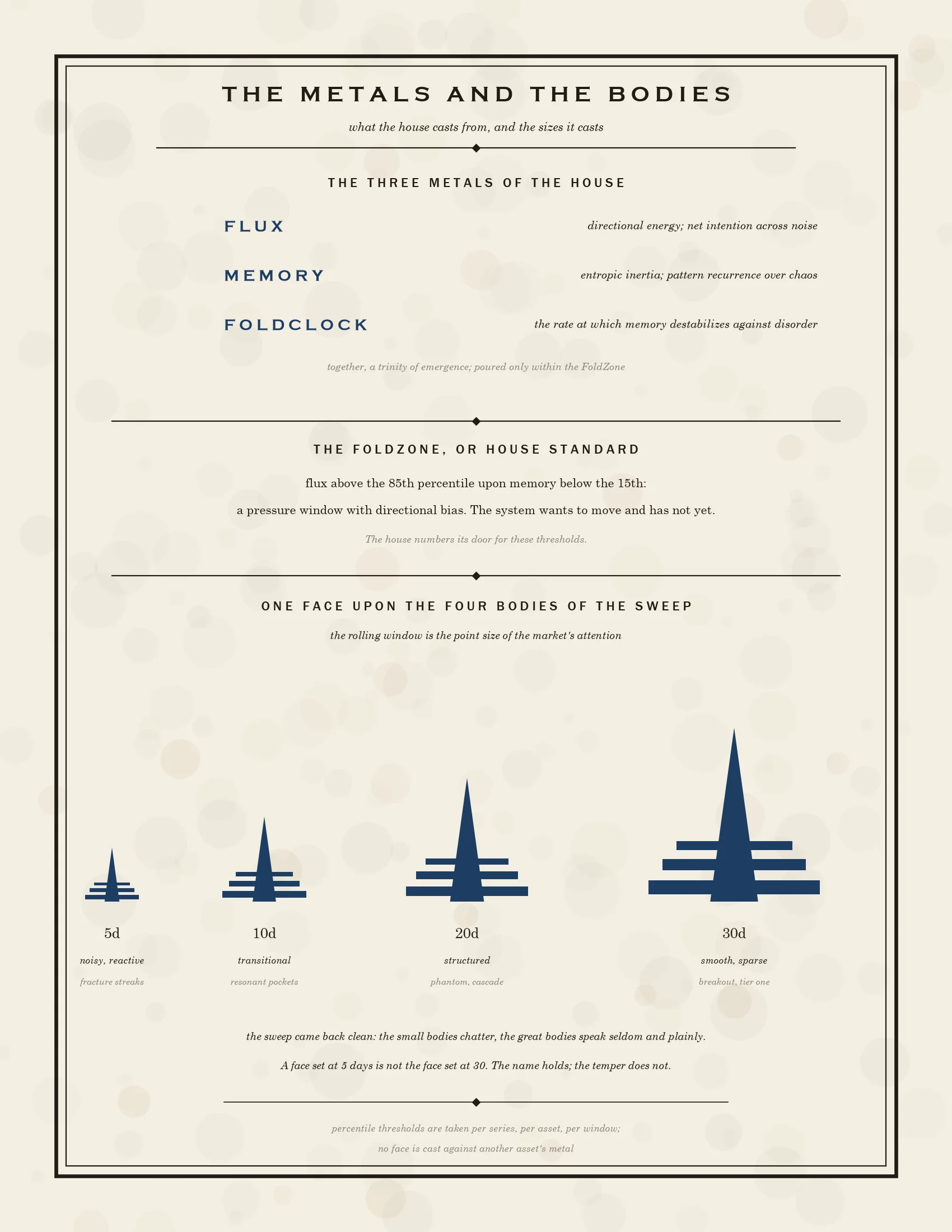
- The bodies. The sweep results table (5d noisy, 10d transitional, 20d structured, 30d smooth) is a size ladder wearing a lab coat, so sheet 3 sets one face on four bodies: the rolling window is the point size of the market's attention. The three metals above it are the Genesis trinity verbatim: Flux, Memory, FoldClock.
- The counterfeit. The Phantom is the corpus's trap glyph, a false breakout that profits by resembling the real one. Every old specimen book carried a notice about counterfeit cuts; this one gets to mean it. The Phantom is cut as the Breakout envelope with no ink inside, and the notice ends on the honest turn: the house validated the counterfeit itself, because knowing the trap is a cut of its own.
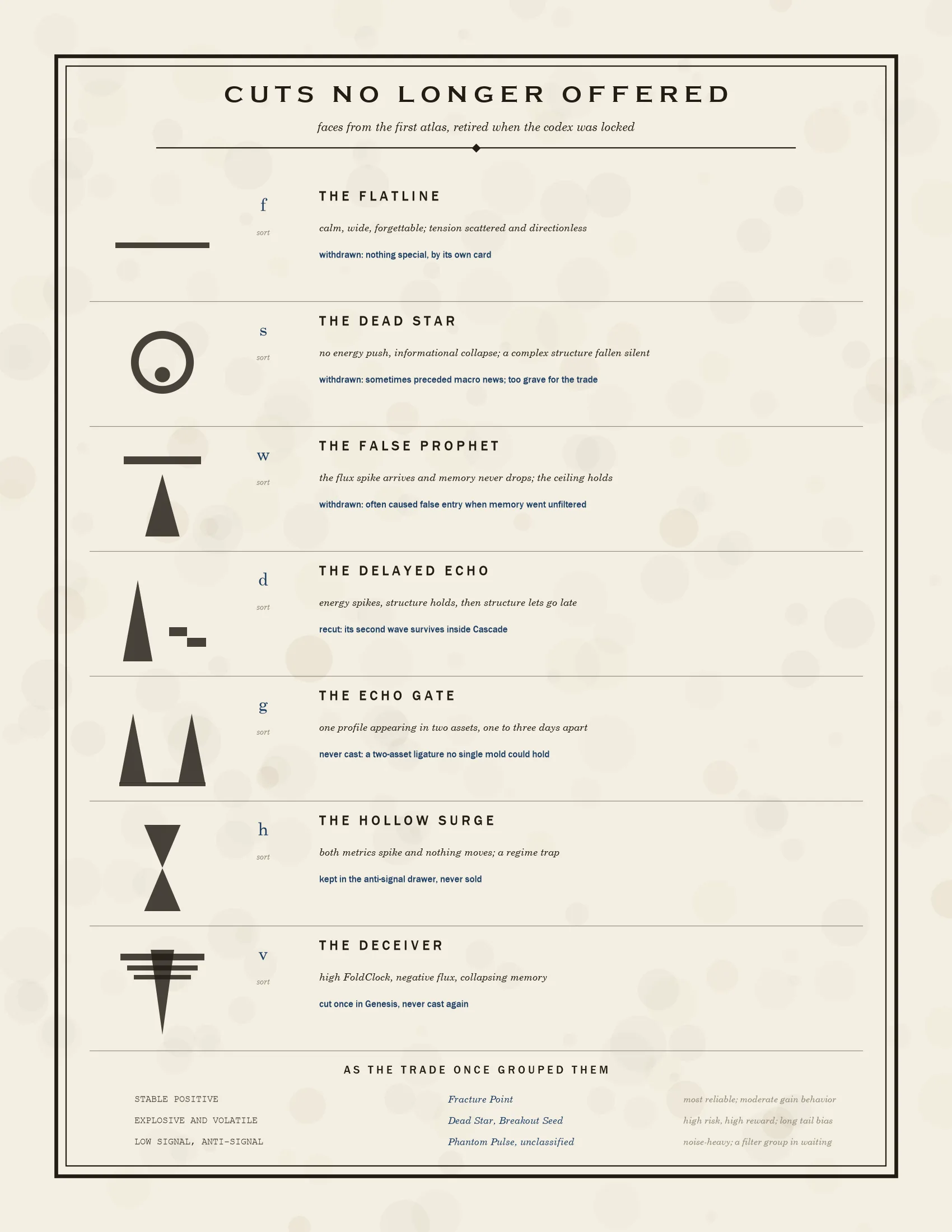
- The discontinued drawer. The January atlas glyphs that never made canon (Flatline, Dead Star, False Prophet, Delayed Echo, Echo Gate, Hollow Surge) get leaving-pages with their own cards quoted as the reason for withdrawal, and the Deceiver, named once in FoldClock Genesis and never mentioned again anywhere in the vault, is filed with the only epitaph it has: cut once in Genesis, never cast again.
- The rare casting. The Phoenix meta-glyph, Decay then Echo then Bloom, poured at most once per asset in ninety days, observed once in XRP at +30.31 percent. It is cut as a three-part ligature and given the page a foundry gives its one showpiece ornament.
The trial, printed anyway
The catalog does not soften nulls, and neither did the source. The Phase 3.1 return profile table is reproduced on sheet 5 at hour scale, where the faces sit within a few parts in ten thousand of plain text, right beside the day-scale numbers where they did well (Fracture +6.1 percent at fourteen days, +13.8 at thirty). Both are real, both are printed, and the sheet says which is which. A foundry that only shows its faces in good light is an advertisement; this one is a record.
Details that carry weight
- The house number is No. 85/15, the FoldZone percentile thresholds, styled as a street address.
- The lineage in the colophon is the vault's own sealed log: SEEM, the Shank Entropy Evolution Model, whence FEEF, whence FoldClock, whence the Codex Engine. The foundry carries the family name because the entropy model literally does.
- The colophon records the shop's hours from the graveyard folder: the open-question lists were saved at 2:38, 3:08, and 3:30 in the morning. The faces were cut in those hours.
- The license line is the Artisan Starter Kit verbatim: governed by the Sigil of Constraint, built to study tension, not to exploit it, and the book closes on its blessing: protect the heart, share the lens. The same license text ships inside the TTF's name table, where font licenses actually live.
- The font's em is 1000 units and every mark on every sheet is drawn from the same path data compiled into the TTF. The book and the fount cannot disagree.