hung 2026-09-02
The Barn Comes Later
a barn quilt for a barn that has not been found yet
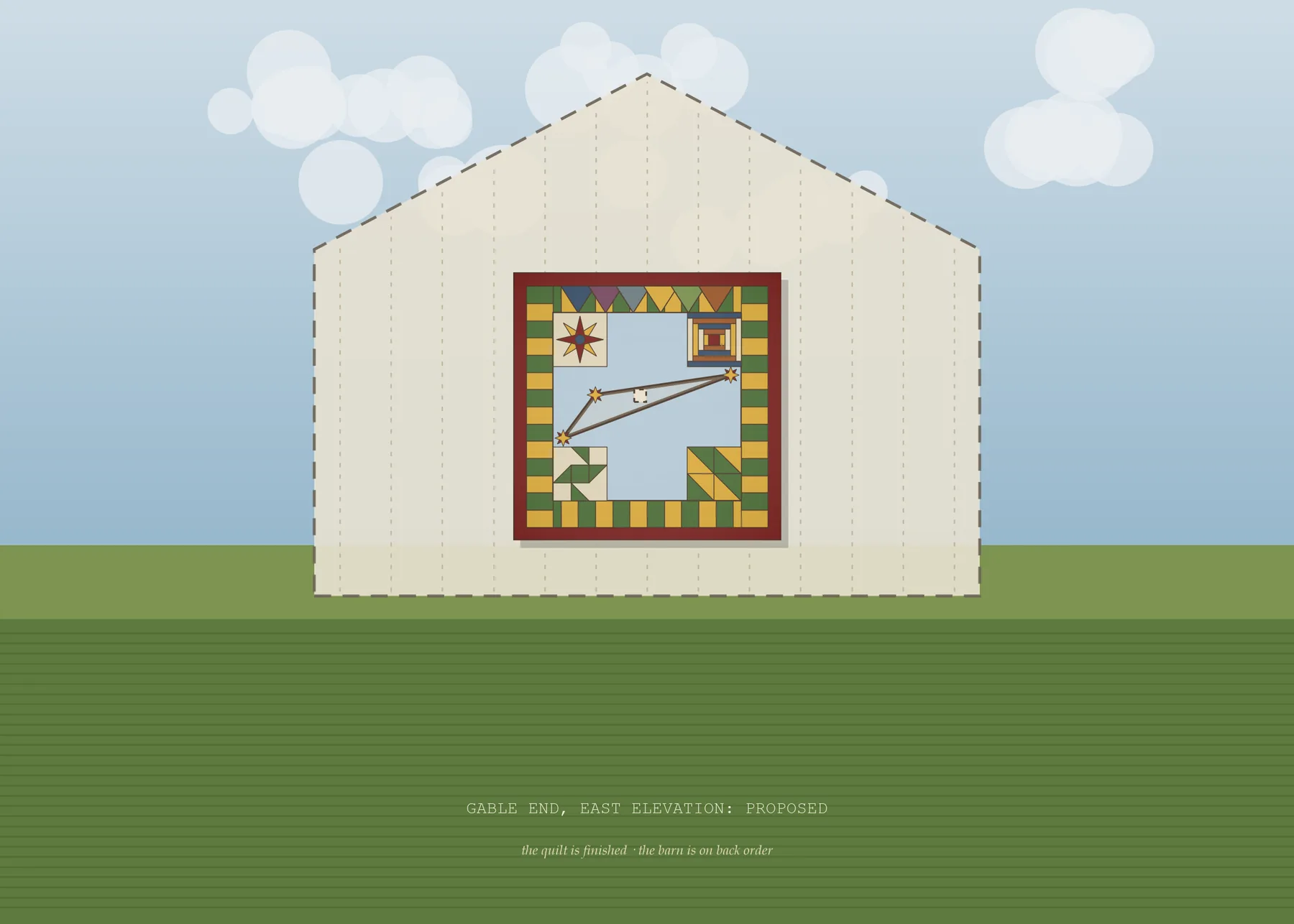
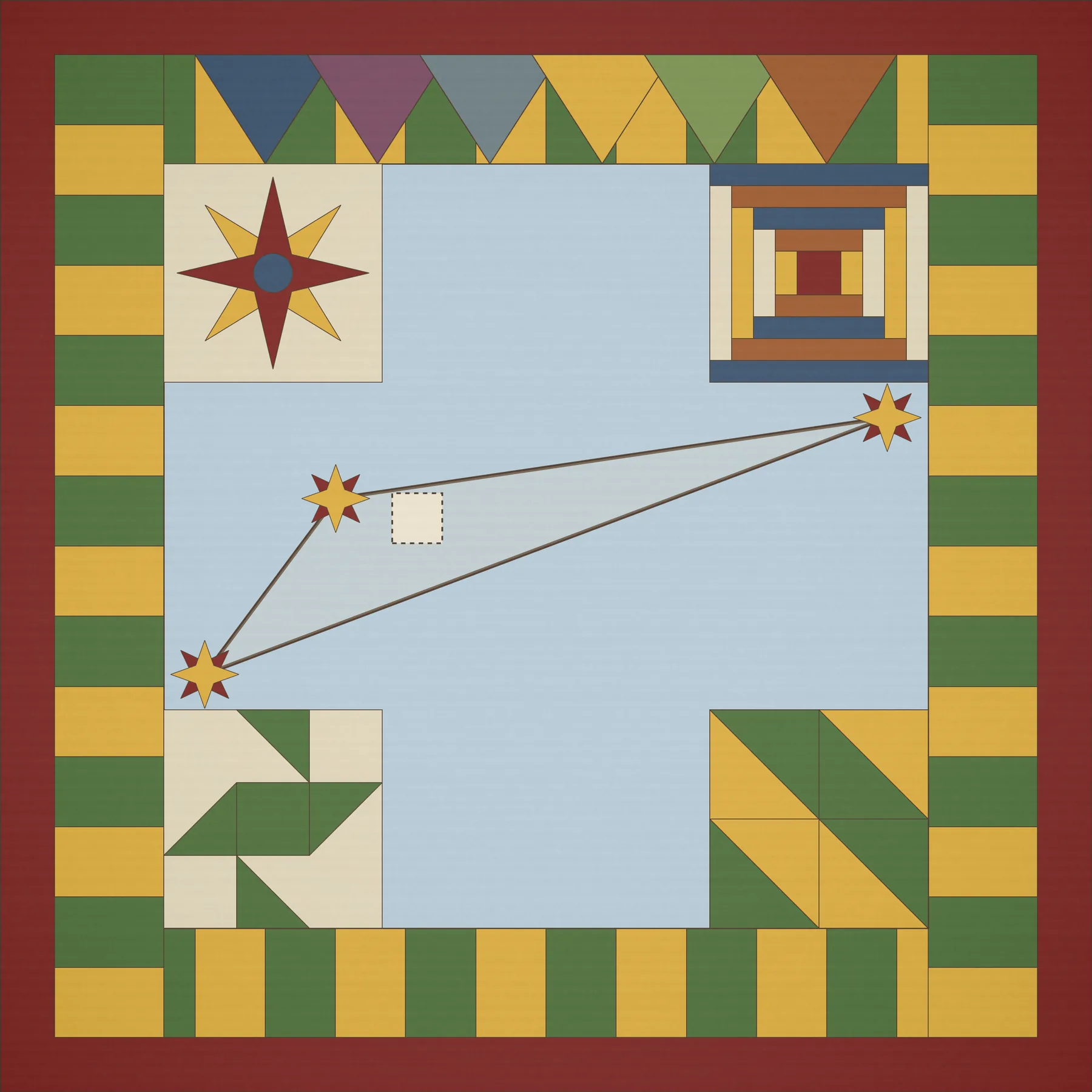
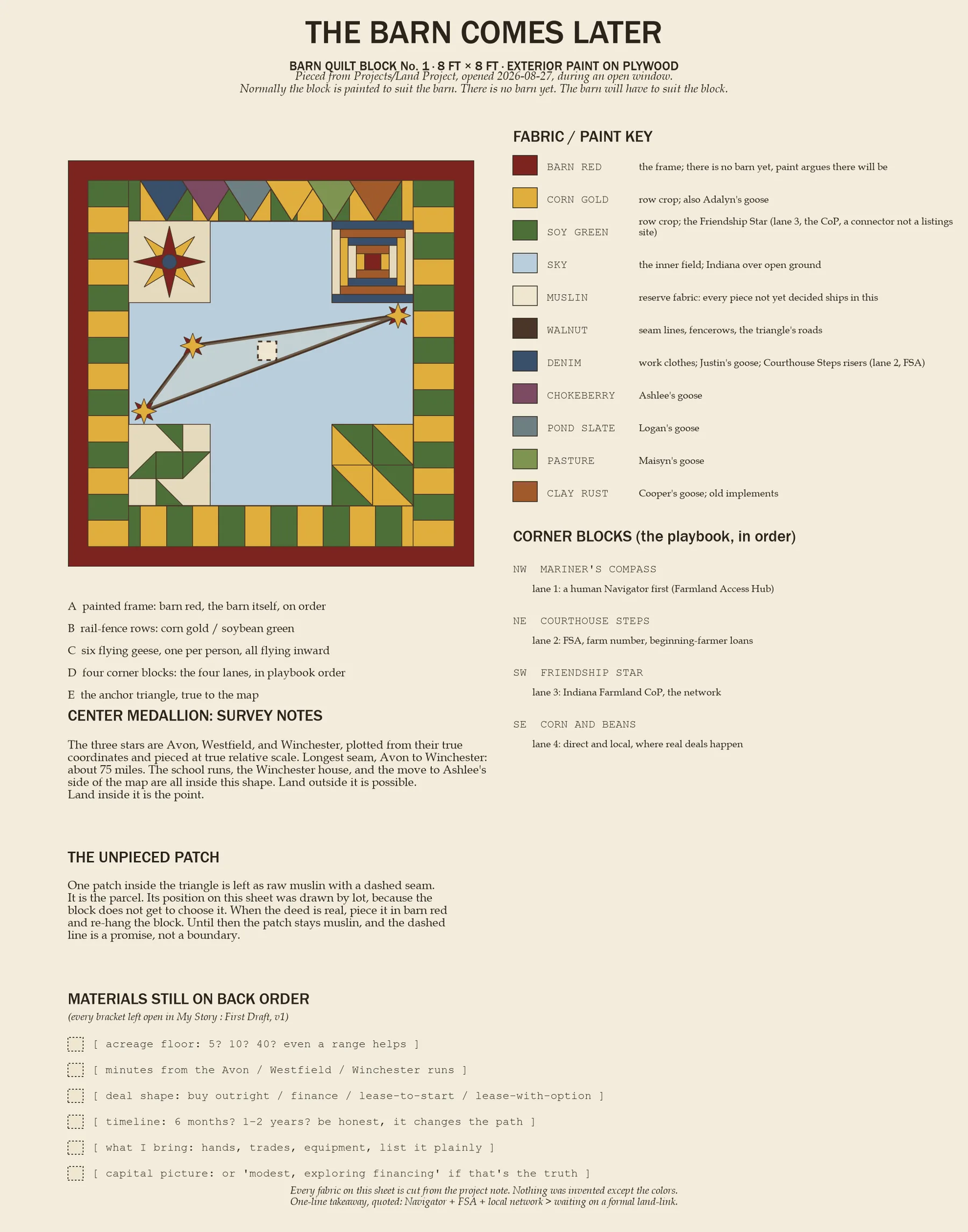
Look: block.png, the quilt block itself, square, wordless, ready to paint at 8 ft × 8 ft. Read the plans: pattern-sheet.png, the pattern card with the fabric key, the four corner blocks, the survey notes, and the materials still on back order. See it hung: barn-mockup.png, the gable end, east elevation, proposed: the quilt painted and solid, the barn around it drawn in dashed line, because only one of the two exists.
The quilt is code: barnquilt.py. Deterministic, seeded at 20260827, the day the Land Project was opened. Run it twice, get the same quilt twice: same block, same pattern sheet, same mockup. Requires Python with numpy and matplotlib, plus the Franklin Gothic Medium, Book Antiqua, and Courier New fonts that ship with Windows. Every shape is drawn; nothing is a texture file.
Source material: the Land Project, read whole, read-only, nothing touched: the project note (2026-08-27, opened during the open window, with the four-lane Indiana playbook) and My Story, first draft (same day, the one-pager that is mostly empty brackets). First creative run into the Land Project, which was six days old on the morning of this run.
Medium shift, per the diversity mandate: the last five runs were a kintsugi sculpture, a Signal Descent film, a cyanotype drawing set, a passport, and a photocopy film. This is folk art: a barn quilt, the first textile-tradition piece in the catalog. Barn quilts are an actual Indiana roadside medium, painted quilt blocks on plywood hung on barn gables, with marked trails through the counties. Palette: barn red, corn gold, soybean green, sky, unbleached muslin, walnut, work denim.
The one idea
A barn quilt is normally the last thing. First the land, then the barn, then, when the farm has a history worth announcing, the block goes up on the gable. The Land Project runs the other direction: it is a want with no parcel, a strategy with no acreage number, a story that is still mostly brackets. So the piece inverts the medium's order of operations. The quilt is finished first, and hangs on a barn that exists only as a dashed outline. The pattern sheet says it plainly: normally the block is painted to suit the barn. There is no barn yet. The barn will have to suit the block.
Everything pieced into the block is cut from the project note:
- The center medallion is the search area, true to the map. The three stars are Avon, Westfield, and Winchester, plotted from their real coordinates and pieced at true relative scale. The note insists on this exact shape: land within workable reach of the triangle, "not just anywhere in Indiana." The longest seam, Avon to Winchester, runs about 75 miles, which is why the triangle is a long sliver instead of a tidy wedge. The block does not clean that up. The school runs are that shape.
- One patch inside the triangle stays unpieced. Raw muslin, dashed seam: the parcel. Its position was drawn by lot from the seed, rejecting any lot that would cross a seam line, because the block does not get to choose where the land is. The pattern card's instruction: when the deed is real, piece it in barn red and re-hang the block.
- The four corner blocks are the playbook's four lanes, in order, each set as a real traditional block whose name does the work: Mariner's Compass for lane 1 (the human Navigator at Farmland Access Hub), Courthouse Steps for lane 2 (FSA, farm number, beginning-farmer loans), Friendship Star for lane 3 (the Indiana Farmland Community of Practice, a connector, not a listings site), and Corn and Beans for lane 4 (direct and local, where the note says the real deals actually happen).
- Six flying geese cross the top border, all flying inward: Justin, Ashlee, Logan, Adalyn, Maisyn, Cooper, one fabric each, converging on the center field. The family is in the frame of the project note, so it is in the border of the block.
- The rail-fence border alternates corn gold and soybean green, row crops around everything, and the outer frame is barn red: the barn itself, on order, paint arguing there will be one.
- The brackets ship as muslin. Every bracket left open in My Story (acreage floor, timeline, deal shape, capital picture, what I bring) is listed on the pattern sheet under "materials still on back order," each with a dashed muslin swatch. The one-pager's blanks are not missing from the piece; they are its reserve fabric.
Details that carry weight
- The mockup reverses the usual figure and ground of an architectural rendering. The building is the ghost; the ornament is the only solid thing. That is an honest elevation of the project as of 2026-09-02.
- The quilt block carries no text anywhere, like a real barn quilt. All the reading lives on the pattern sheet, the way piecing knowledge actually travels: block on the barn, pattern in a drawer.
- The lot for the parcel patch is a seeded Dirichlet draw over the triangle, first draw that fits wholly inside. With seed 20260827 it lands just south of the Westfield star, which the piece takes no position on.
- The quoted takeaway at the foot of the pattern sheet is the project's own: Navigator + FSA + local network > waiting on a formal land-link.