hung 2026-08-14
Refusal Is a Correct Move
the round game of What Cannot Be Done
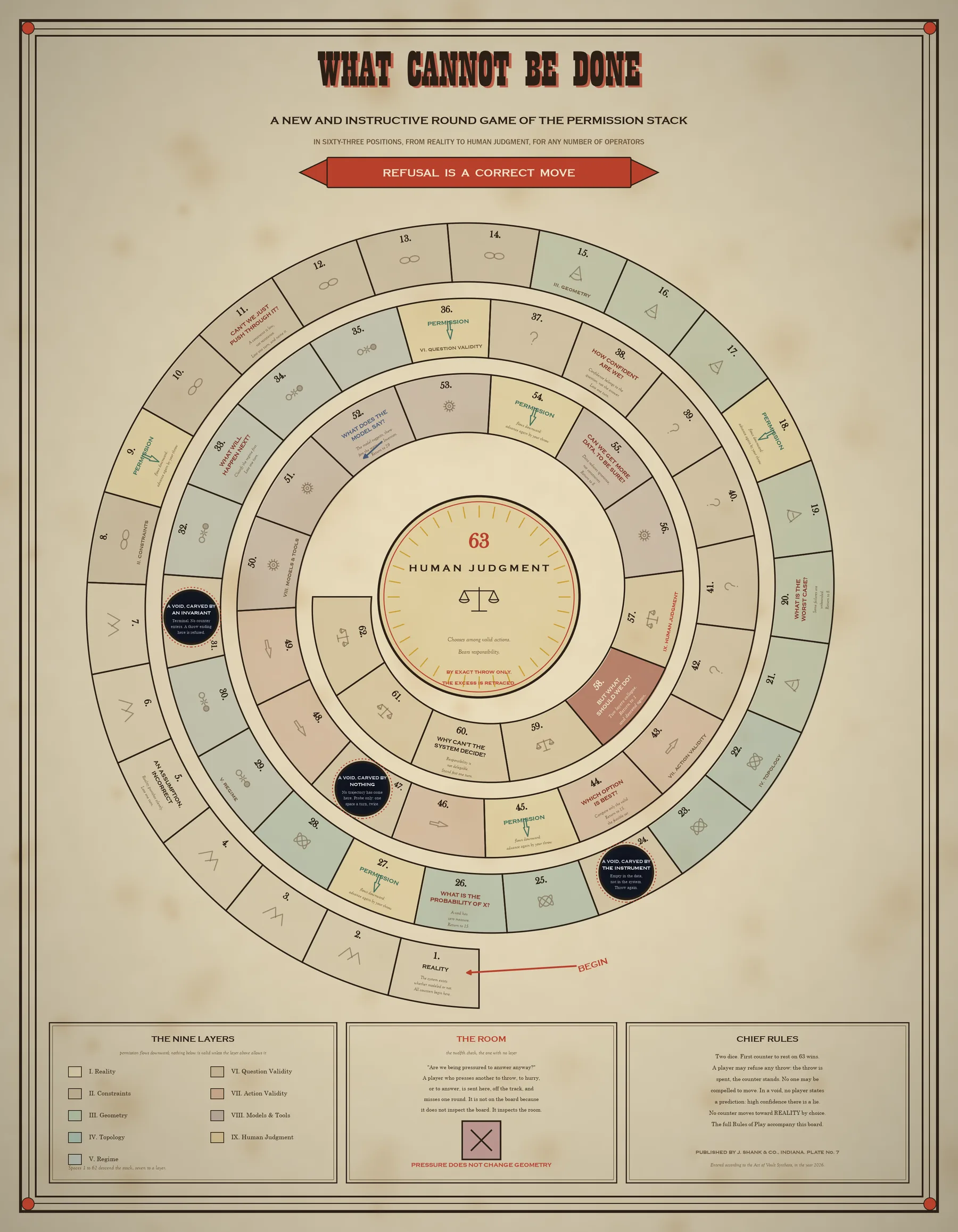
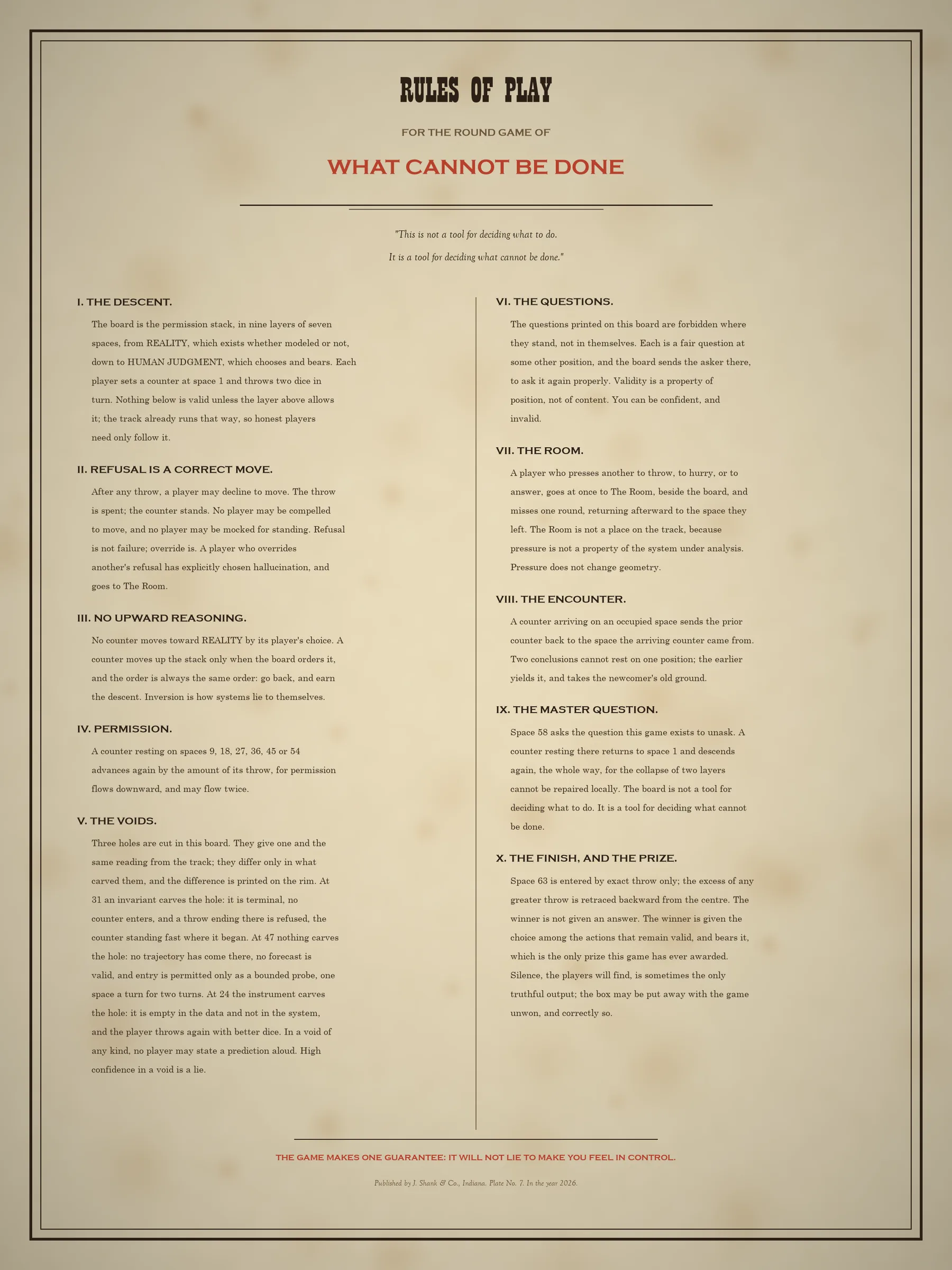
Open: board.png. One game board, 14x18 in at 200 dpi, chromolithograph on aged stock. Print it, find two dice and two counters, and it plays. Then: rules.png. The letterpress Rules of Play, ten rules in two columns. The board carries the chief rules; this sheet carries the voice. The game is code: game.py. Deterministic, seeded at 20260116, the earliest file timestamp in the Topology-Driven Decision Engine corpus. Run it twice, get the same board, the same rules sheet, and the same specimen game twice. Requires Python with numpy and matplotlib, plus the Playbill, Baskerville Old Face, Copperplate Gothic Bold, Century Schoolbook, Franklin Gothic Medium, and Goudy Old Style fonts that ship with Windows.
Source material: Section 7 of the vault synthesis arc, read whole, read-only, nothing touched: README, CATALOG, OPUS-INTERNAL, with SOURCES as the map. First creative run into the synthesis-arc projects since Sections 8 and 10.
Medium shift, per the diversity mandate: prior runs were interactive HTML, a GeoCities shrine, a star plate, an audio étude, a fingerprint SVG, a blueprint, a cross-stitch sampler, a film, a stamp sheet, a dressmaking pattern, a nautical chart, a player piano roll. This is the first game: a printable board game in the manner of the Game of the Goose, the oldest printed board game in Europe. New palette too: chromolithograph stones on aged board stock, vermilion, chrome yellow, viridian, slate, with the color layers deliberately misregistered a few points off the black keyline, the way the cheap stones always drifted.
The one idea
Section 7's catalog generalizes the whole corpus into one sentence: validity is a property of position, not of content. A question is not forbidden by what it asks but by where it is asked from. There is exactly one artifact form in Western culture where position is the entire content: the board game. A square is a rule about a position. So the synthesis becomes a game, and the fit turns out to be indecently good, because the Game of the Goose already had the required skeleton in the 1590s: sixty-three spaces, a spiral, hazards that send you backward, a well you cannot leave, death at space 58, and a finish that demands an exact throw.
The mapping, square by square:
- The track is the permission stack. Nine layers of seven spaces, Reality at the rim, Human Judgment at the center. Permission flows downward; so does the spiral.
- The goose squares became PERMISSION squares (9, 18, 27, 36, 45, 54): land there and advance again, because permission flows downward and may flow twice.
- The forbidden questions are printed on the spaces where they fail, each with its penalty pointing at the layer where its allowed replacement lives. "What is the probability of X?" fails at Topology and sends you back to Geometry. "Which option is best?" fails at Action Validity and sends you back to the feasible set. The questions are forbidden where they stand, not in themselves. That is the thesis, played.
- The three voids are the catalog's Part I, cut into the board as actual holes, one per type, identical from the track, distinguished only by what carved them. Invariant-carved (31, where the goose's well always was): terminal, no entry, a throw ending there is refused. History-carved (47): no forecast, bounded probe only, one space a turn for two turns. Instrument-carved (24): empty in the data, not in the system, throw again. Refusal to predict is unconditional in all three; that is Rule V, and the reconciliation is now a piece of game furniture.
- Death at 58 is the Master Question. "But what should we do?" collapses two layers and cannot be repaired locally: return to 1 and descend again. The goose put death at 58 four centuries ago; the corpus put its most dangerous question in the same place without knowing it.
- Inversion is space 52: "What does the model say?" The canonical upward move, with a wrong-way arrow, sent back to Regime.
- Check 12 is The Room, drawn beside the board because it is the one check with no layer. It does not inspect the board; it inspects the room. Pressure a player and you go there. Pressure does not change geometry.
- The finish keeps the goose's exact-throw rule because the corpus already states it: an overshoot is not a win, the excess is retraced. Validity is a property of position. And the winner is not given an answer; the winner is given the choice among valid actions, and bears it.
The signature rule is Rule II, and it is the title: after any throw, a player may refuse to move. The throw is spent, the counter stands, and nobody may be compelled or mocked. "Refusal Is a Correct Output" was one of the section's carried title alternatives; one word swapped makes it a rule of play. The rules sheet closes on the ANTI-README's guarantee, verbatim: the game will not lie to make you feel in control.
The specimen game
The code plays one deterministic game to prove the rules terminate (honest players: refuse any throw that ends on a send-back square, since Rule II beats the penalty). Seeded at 20260116: Slate wins on the 26th throw; Vermilion refuses three times and is standing at 50 when it ends. The refusing player loses this particular game and is never once invalid, which the corpus would count as the better record.