hung 2026-08-18
Possibly Ritual
an excavation report for a grave that was never dug
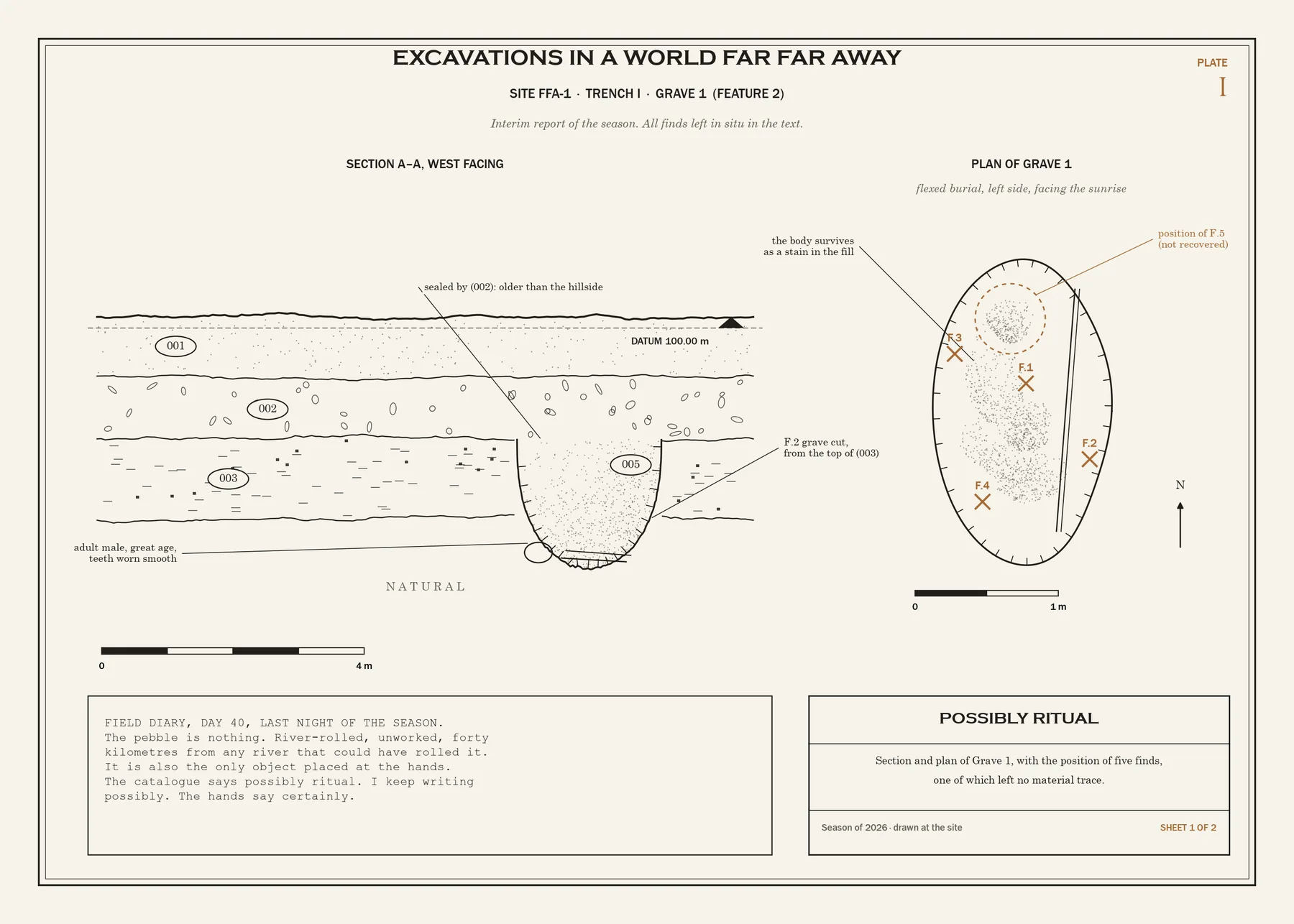
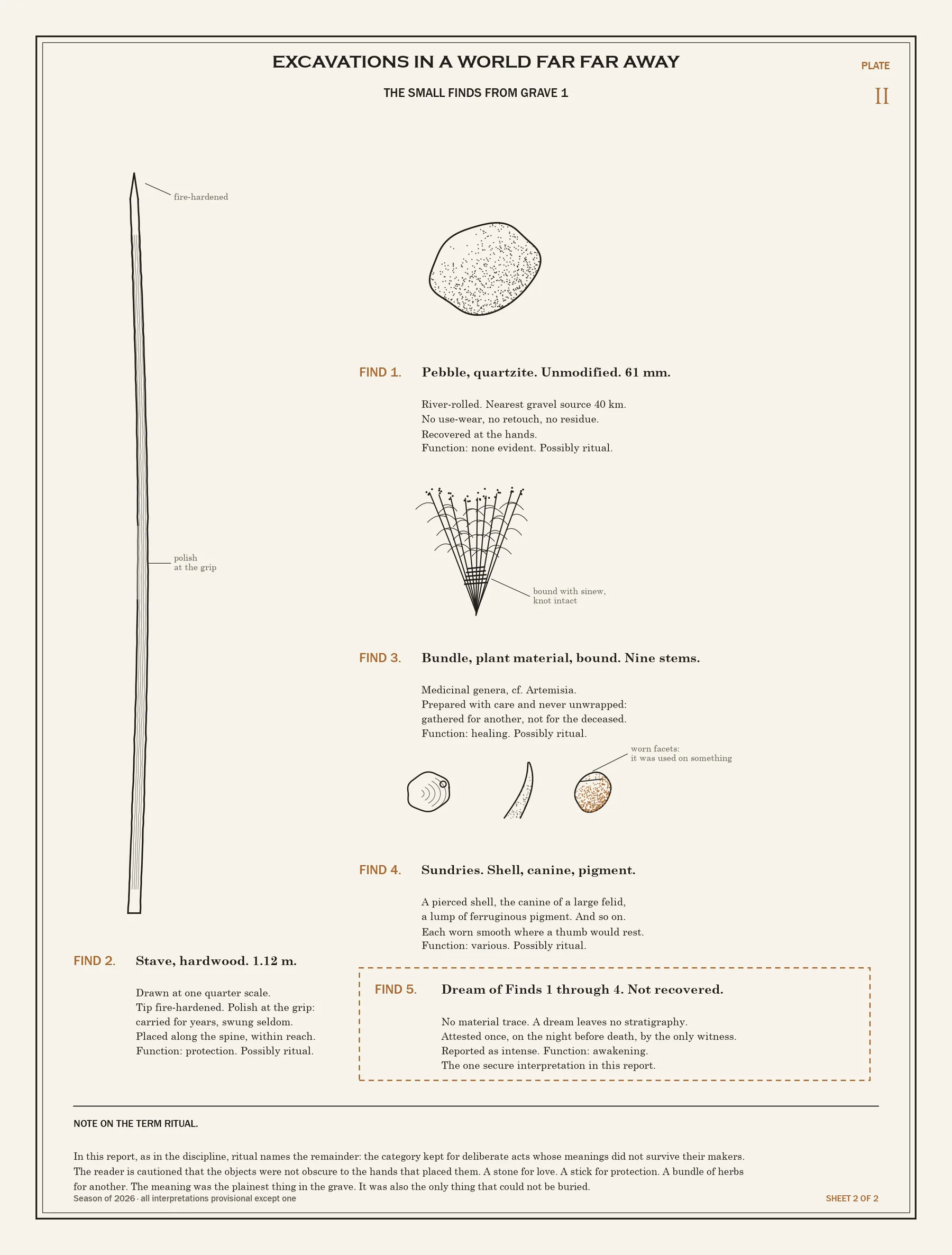
Open: plate1-section-and-plan.png, the section and plan of Grave 1, then plate2-the-small-finds.png, the small-finds catalog. Two report sheets from Excavations in a World Far Far Away, Site FFA-1. Print them and they pass for pages pulled out of a county archaeology unit's interim report, except for what the catalog is forced to admit. The report is code: report.py. Deterministic, seeded at 20260808, the day the story was written. Run it twice, get the same two sheets twice. Requires Python with numpy and matplotlib, plus the Century Schoolbook, Franklin Gothic Medium, Copperplate Gothic Bold, Goudy Old Style, and Courier New fonts that ship with Windows.
Source material: Grandfather Ape Story (vault root, 2026-08-08), read whole, read-only, nothing touched. A ten-sentence fable, human-written, about an old ape at the end of an easier life than his great-grandfather's, who could say the things that mattered and then fastened each one to an object: "A stone for love. A stick for protection. A bundle of herbs for another and so on." On the night before his death he dreamed of the objects, and the dream was intense, and he woke knowing his sons and his sons' sons would have the same dream. First creative run into this note.
Medium shift, per the diversity mandate: prior runs were interactive HTML, a GeoCities shrine, a star plate, an audio étude, a fingerprint SVG, a blueprint, a cross-stitch sampler, two films, a fax-tone hymn, a stamp sheet, a dressmaking pattern, a nautical chart, a player piano roll, a board game, a pair of volvelles, a numbers station, and a seed catalog. This is dig paperwork: a stratigraphic section, a burial plan, and a small-finds plate, the paper archaeology actually produces. New palette too: white report stock, india ink, pencil grey, and a single ochre used only for find spots, plate numerals, and one lump of pigment.
The one idea
Archaeology has a standing confession built into its vocabulary. When an object is deliberate but its meaning did not survive, the discipline files it under ritual. Possibly ritual. The word is a shrug wearing a lab coat.
The Grandfather Ape Story is the view from the other side of that shrug. The ape knew exactly what the stone meant. He made it mean. The story is about the moment meaning got fastened to objects at all, which is the moment that makes archaeology possible and the moment archaeology can never reach. So the piece excavates his grave and writes the honest report: five finds, four recoverable, every interpretation a hedge. Find 1, a pebble with no function, at the hands: possibly ritual. Find 2, a stave carried for years and swung seldom: possibly ritual. Find 3, nine stems bound with sinew, gathered for another and never unwrapped: possibly ritual. Find 4, the sundries, quoting the story's own inventory clause: "And so on. Possibly ritual."
Find 5 is the dream. It gets a dashed ochre outline at the cranium on the plan, an empty dashed box in the catalog, and the only confident line in the report: not recovered, no material trace, a dream leaves no stratigraphy. Function: awakening. The one secure interpretation in this report. The one thing the trowel cannot touch is the one thing the source states outright. Everything durable is uncertain; the only certainty is the thing that left no trace.
The plate closes with a note on the term: the objects were not obscure to the hands that placed them. The meaning was the plainest thing in the grave. It was also the only thing that could not be buried.
Details that carry weight
- The body survives only as a stain in the fill. Even the ape barely outlasts his objects. The stain is stippled, never outlined: the report refuses to draw a line it did not observe.
- Find 3's stems are identified as cf. Artemisia, which is both a real medicinal genus (wormwood, mugwort) and a quiet wave at the vault's own Artemis lane.
- The field diary on Plate I is the excavator cracking: "The catalogue says possibly ritual. I keep writing possibly. The hands say certainly."
- The grave is sealed by colluvium, "older than the hillside," and the burial faces the sunrise, because the story is set at the beginning of everything and the ape woke.
- Footer of Plate II: "all interpretations provisional except one."