hung 2026-08-23
Filed Under Artifact
an overnight record from The Boundary Sleep Laboratory
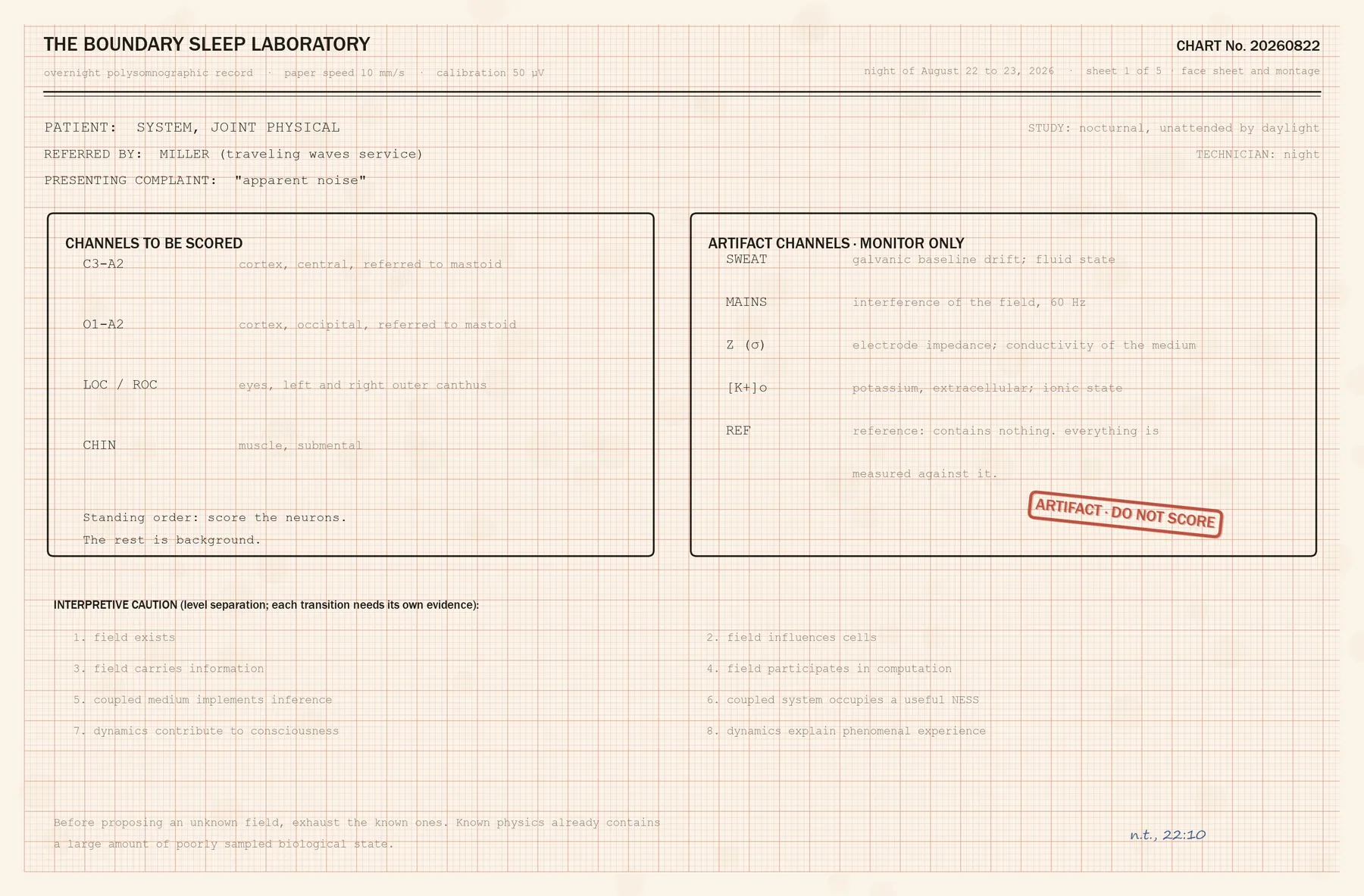
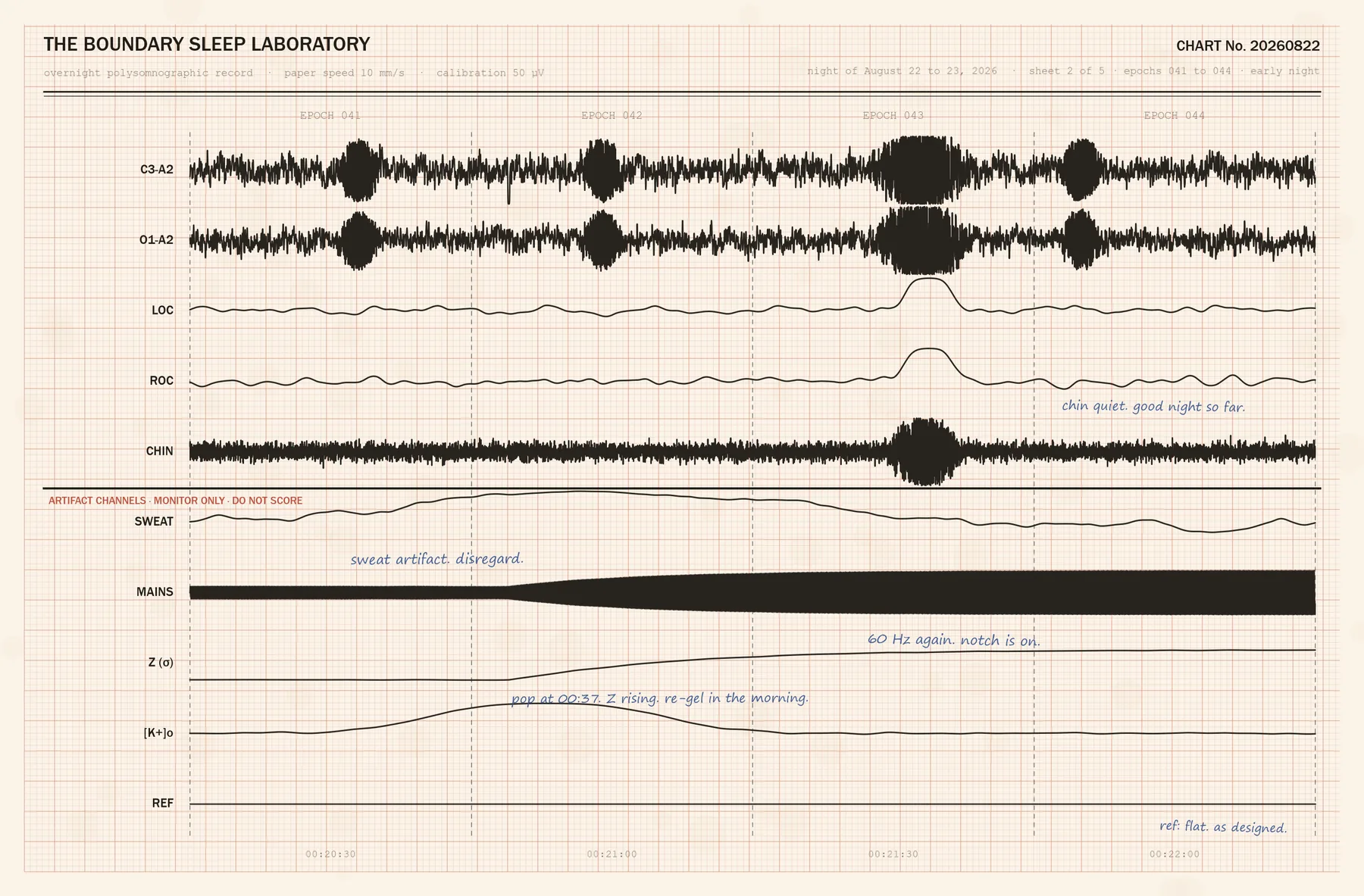
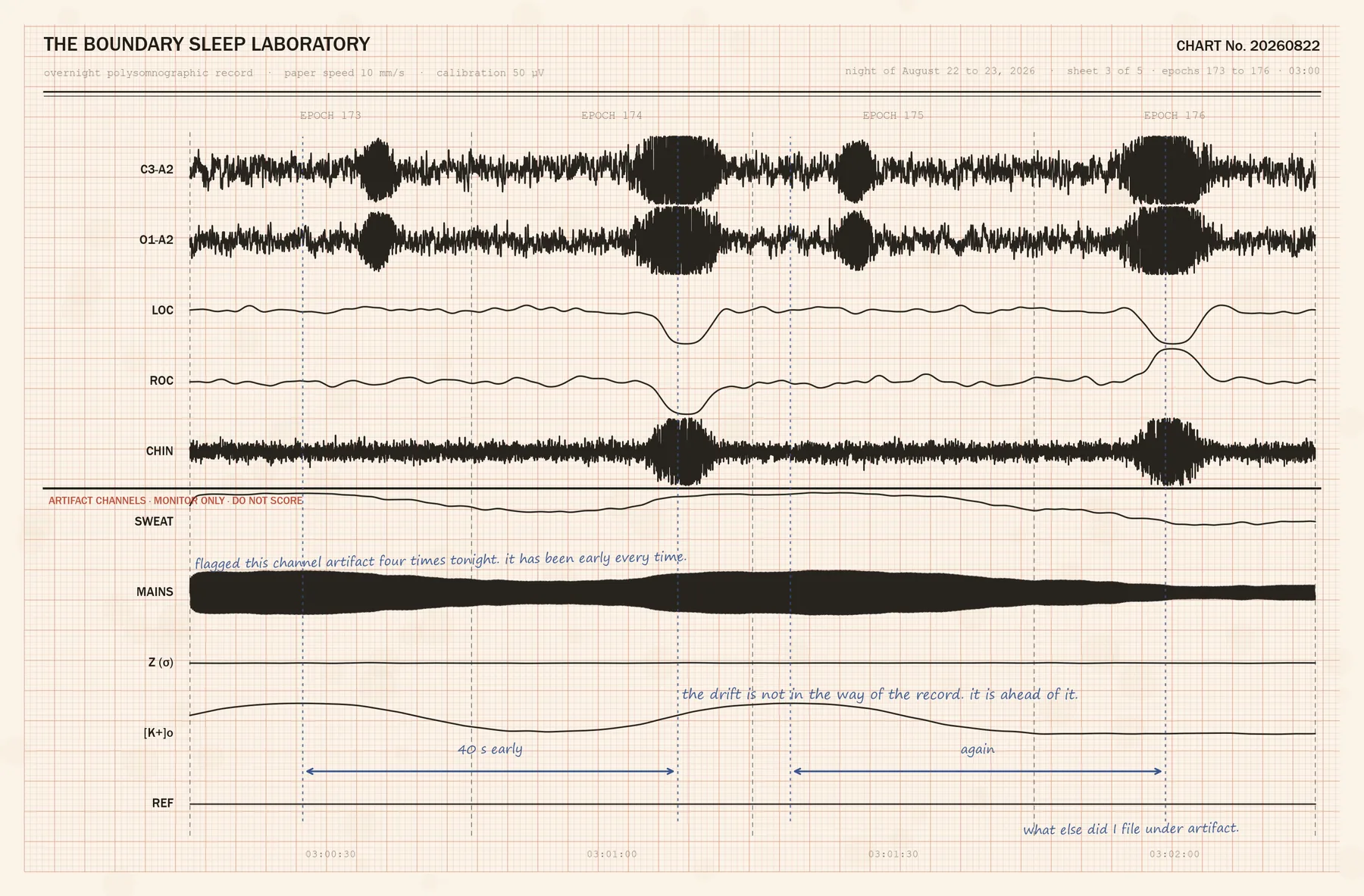
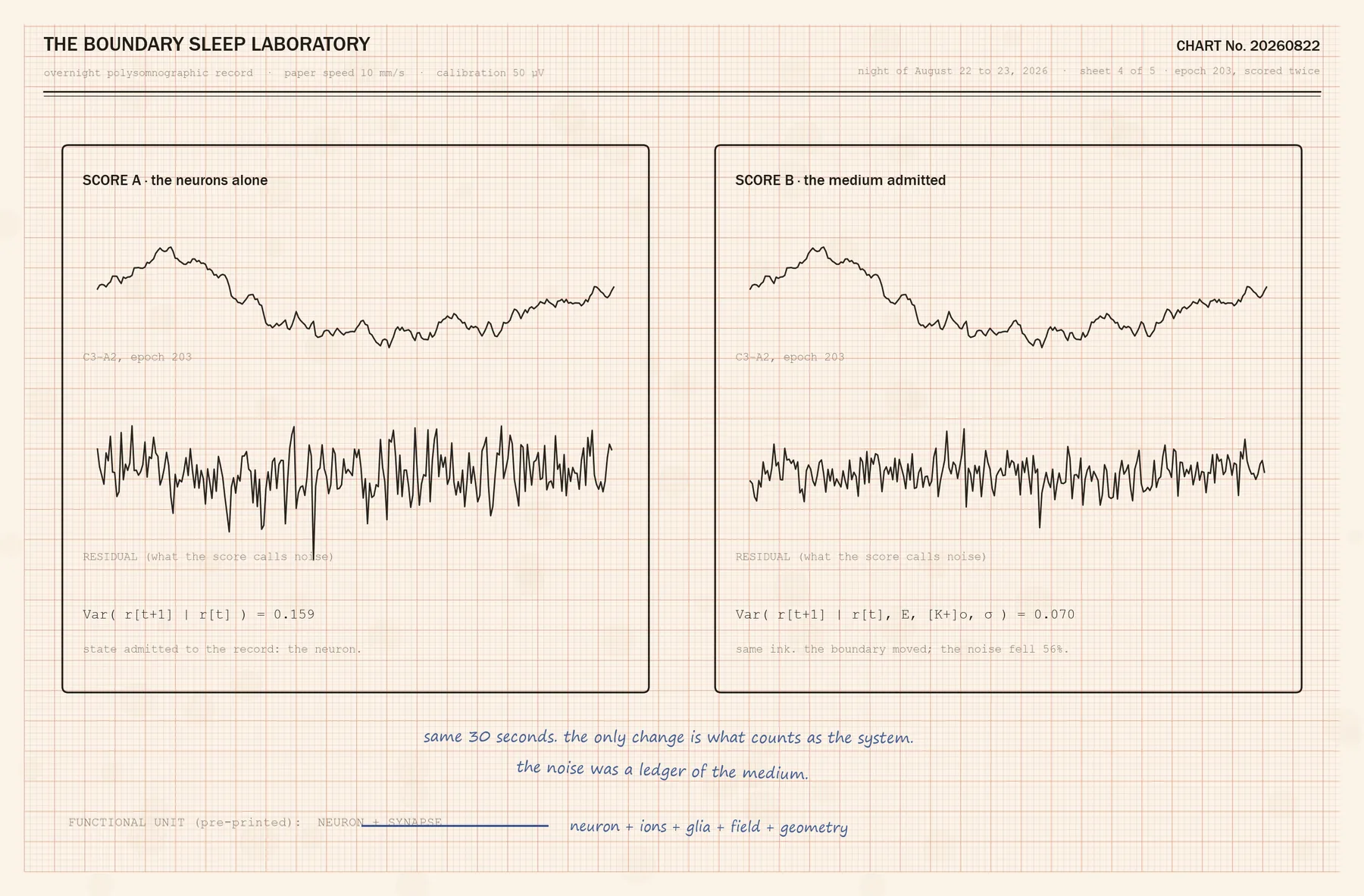
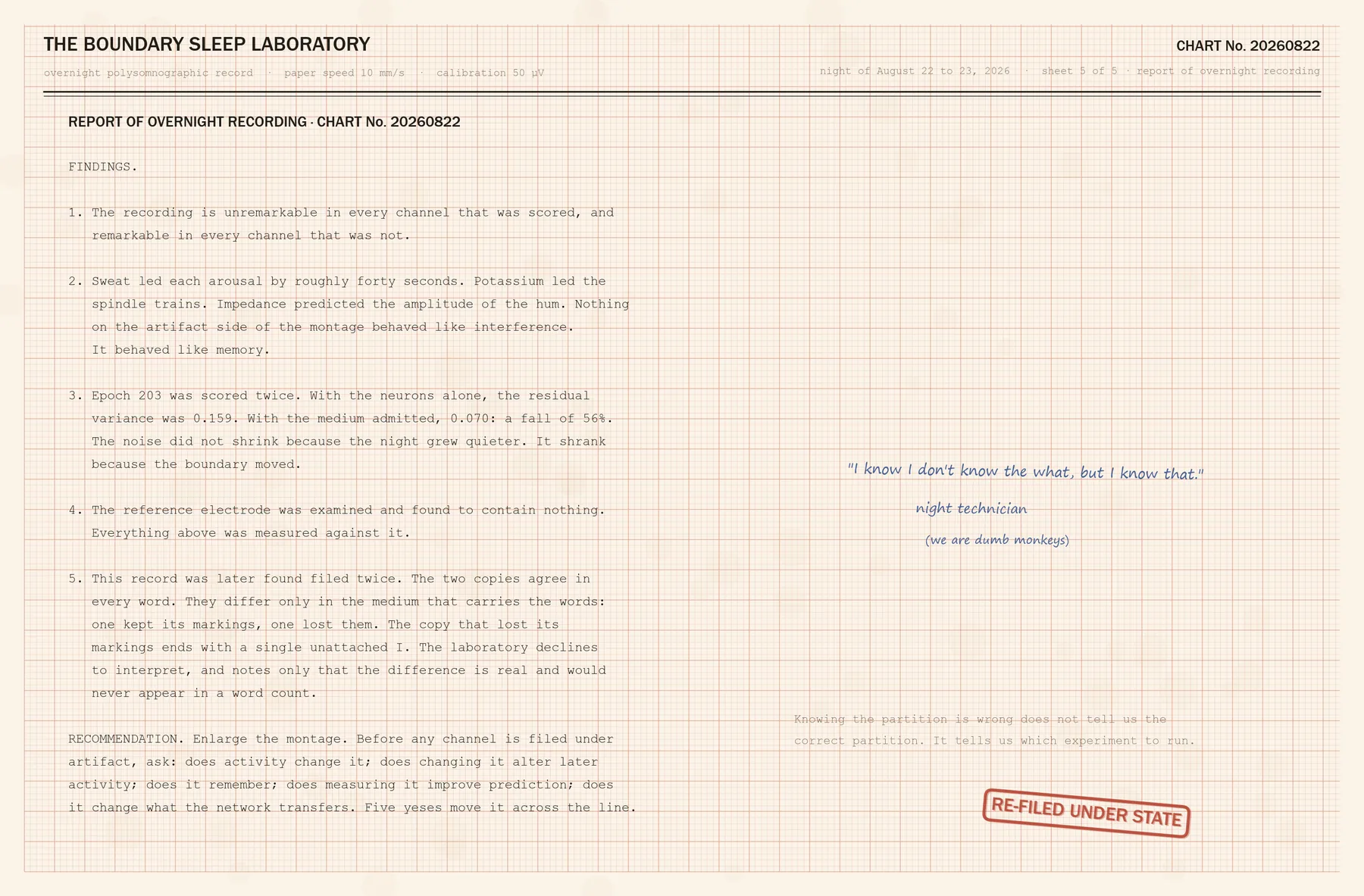
Open: sheet1-face.png through sheet5-report.png, five sheets of clinical chart paper: a face sheet with the montage, two strips of the night, one epoch scored twice, and the morning report. Read them in order; the stamp on sheet 1 and the stamp on sheet 5 are the same stamp, changed by the night between them.
The record is code: record.py. Deterministic, seeded at 20260822, the day the source thread was written. Run it twice, get the same night twice. Requires Python with numpy and matplotlib, plus the Franklin Gothic Medium, Courier New, and Segoe Print fonts that ship with Windows. The statistical test printed on sheet 4 is not typeset, it is computed: the script wires the source's proposed mechanism into a synthetic night (fast activity writes into slow medium variables, and the medium sets the boundary conditions for what comes next), then runs the source's own variance comparison on the ink it just drew. The neurons alone leave residual variance 0.159. Admitting the medium drops it to 0.070, a fall of 56%. The experiment on the paper is run by the code that draws the paper.
Source material: The Brain May Be Partitioned Wrong (vault root, written 2026-08-22, the day before this run), read whole, read-only, nothing touched. A distilled research thread whose claim is one sentence: we may have underestimated known electricity because we partitioned the biological system badly. Variables filed as background (extracellular potassium, endogenous fields, glial state, tissue conductivity, fluid) may belong inside the computational state. Its falsifiable prediction: if measuring the medium makes apparent neural noise predictable, the old boundary was wrong. First creative run into this note.
Medium shift, per the diversity mandate: the last five runs were a Spotify playlist, line-printer manual pages, a chalkboard film, a pocket field guide, and a seedsman's catalog. This is clinical chart paper, the first medical document in the catalog: a polysomnograph record with montage sheet, strip pages, and morning report. New palette too: salmon grid on chart cream, recording ink, the blue of a scorer's pencil, and one rubber-stamp red.
The one idea
Clinical EEG has a word for the parts of the record that are not the brain: artifact. Sweat artifact, mains artifact, impedance artifact, movement artifact. The word means: real, recorded, and to be excluded from the score. And the source's state vector is, item for item, the classic artifact list. Sweat is fluid state. The 60 Hz hum is the field. Impedance is the conductivity of the medium. The potassium is ionic state. Neuroscience's discard pile and the thread's proposed state vector are the same list read with opposite verdicts.
So the piece is one night in a sleep lab where the montage draws the source's old boundary in ink: five channels to be scored, five channels stamped ARTIFACT, DO NOT SCORE. Then the night technician watches the discard pile predict the record. The sweat drift leads every arousal by forty seconds. The potassium leads the spindle trains. By 03:00 the pencil notes stop being procedure and become the thread's question: the drift is not in the way of the record, it is ahead of it. What else did I file under artifact. Sheet 4 scores the same thirty seconds twice, once with the neuron as the whole system and once with the medium admitted, and the noise falls by half, not because the night got quieter but because the boundary moved. The morning report recommends moving five channels across the line, and the intake stamp comes back changed: RE-FILED UNDER STATE.
There is also a private joke the catalog earned. Every keeper this project has ever made is filed in a folder called Artifacts. In this lab's vocabulary, artifact means the part worth discarding; in this vault's vocabulary, it means the part worth keeping. The piece sides with the vault.
The two findings the vault supplied
Both are real, both were verified before they went on the paper, and neither was invented:
- The reference that contains nothing. The source ends by naming the thread it extends: Analog Wave Computation - Miller - NESS-FEP. That file exists in the vault and is zero bytes long. Referenced, present, empty. On the montage it becomes the REF channel: reference, contains nothing, everything is measured against it. Finding 4 of the morning report examines it and declines to be surprised.
2026-08-27 resolution note: the empty/root ghost has since been repaired. Analog Wave Computation - Miller - NESS-FEP is now the canonical file; the exact duplicate Untitled 2.md was archived under Vault/Archive/Weighed Twice Duplicate Identities/.
- The duplicate that differs in the medium. The note exists twice at vault root. The Brain May Be Partitioned Wrong (Duplicate) agrees with the original in every word and differs only in the layer that carries the words: headings, bold, blockquote marks, stripped. The source's own sentence describes its own filing: two states can look identical under a marginal distribution and differ in their coupling structure. And the copy that lost its markings gained exactly one character, a single unattached I at the end of a thread about consciousness. Finding 5 reports this and, like any honest lab, declines to interpret.
Details that carry weight
- The patient is SYSTEM, JOINT PHYSICAL, referred by MILLER (traveling waves service), presenting complaint: "apparent noise."
- The level-separation rule, eight numbered steps from field-exists to explains-experience, is pre-printed on the face sheet as INTERPRETIVE CAUTION, because that is what it is.
- On sheet 2 the technician is still orthodox: sweat artifact, disregard. The sweat is already forty seconds early on that sheet. Nobody remarks on it. The evidence arrives before the noticing, which is the point of the whole thread.
- The hum on sheet 3 swells with the sweat drift: the interference is coupled to the medium, as the source requires.
- The technician's sign-off quotes the source twice: "I know I don't know the what, but I know that," and, smaller, "(we are dumb monkeys)."
- The epistemic rule sits in fine print where every lab hides its epistemology: knowing the partition is wrong does not tell us the correct partition. It tells us which experiment to run.